
What Factors Affect AI Football Prediction Accuracy?
AI football prediction accuracy is shaped by five core factors: data quality, model architecture, league data depth, squad availability timing, and match unpredictability. No model eliminates all error because football contains irreducible randomness. The best systems achieve 65 to 72% accuracy on 1X2 outcomes across Europe's top leagues.
Why Does AI Football Prediction Accuracy Vary Between Models?
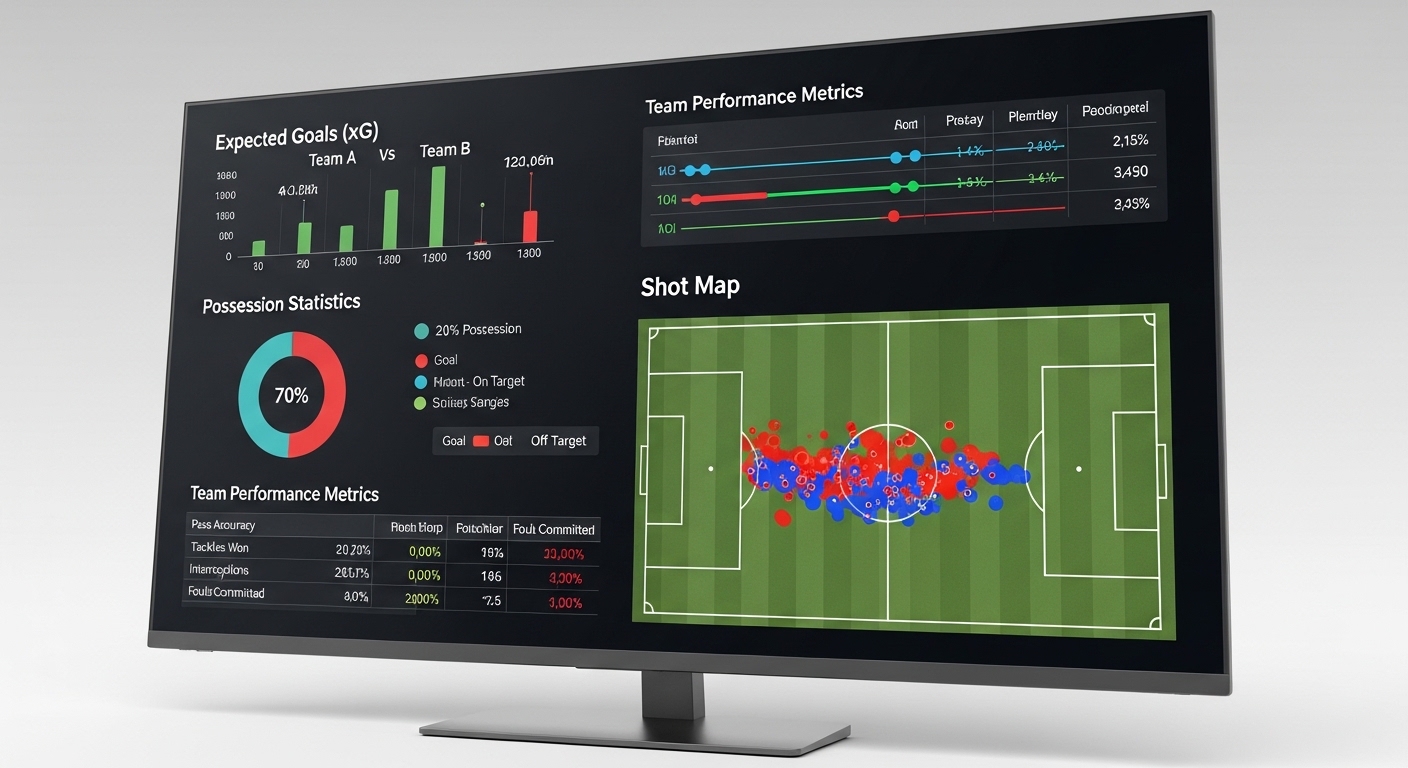
Not all AI football prediction models are built the same way. Some train on raw scorelines from public databases. Others ingest granular event-level data including xG, shot locations, pressing intensity, and defensive line metrics from providers like StatsBomb. The difference in input quality alone accounts for a significant portion of the accuracy gap between basic and advanced prediction systems.
Model architecture is the second major variable. A fixed-weight formula applies the same logic to every fixture regardless of context. A trained machine learning model adjusts its outputs based on patterns it learned from thousands of historical matches, including patterns a human analyst would never think to specify manually. The result is that two models receiving the same basic inputs can produce materially different accuracy figures depending on how well the model was designed and trained. For a deeper look at how model architecture affects outputs, see our guide on how a football prediction algorithm works.
How Does Data Quality Affect AI Football Prediction Accuracy?
Data quality is the single biggest controllable factor in AI football prediction accuracy. A model trained on xG, shot maps, and possession-adjusted defensive metrics produces substantially more accurate predictions than one trained on goals scored and league position alone, because it captures the underlying performance level of each team rather than just the outcomes that performance happened to produce on a given day.
Data freshness matters equally. A model updated with the most recent five matches carries more predictive signal than one last updated before the previous gameweek. According to FBRef, team xG figures from the most recent six matches predict future performance more reliably than season-long averages, because recent data reflects the current squad, tactical setup, and fitness levels more accurately than older data diluted by an earlier period. Stale data is one of the most common and least discussed sources of prediction error in football AI tools.
For the full breakdown of which data inputs matter most and why, see our guide on what data AI uses to predict football matches.
How Does League Data Depth Affect Prediction Accuracy?
AI football prediction accuracy drops significantly in leagues where granular match data is limited. Top European leagues such as the Premier League, La Liga, Serie A, Bundesliga, and Ligue 1 have decades of structured data available, including event-level xG and player tracking from multiple providers. This data depth allows models to learn robust patterns that generalise well to new fixtures within those competitions.
Lower-division and non-European leagues present a different picture. When a model has only two or three seasons of basic match data available for a competition, it cannot learn the kind of nuanced patterns that produce high accuracy. The Premier League alone has over 30 seasons of structured data covering thousands of matches, giving models trained specifically on it a substantial accuracy advantage over models generalising across competitions with thin data. This is why accuracy claims should always specify which leagues they apply to: a system achieving 70% on Premier League 1X2 may perform considerably worse on a second-tier competition.
How Does Squad Availability and Team News Affect Prediction Accuracy?
Squad availability is the most impactful short-term variable on AI prediction accuracy. A confirmed absence of a first-choice goalkeeper or starting centre-back shifts expected goals conceded projections enough to move result probabilities by 4 to 8 percentage points on average. The challenge is timing: official confirmed lineups are only published 60 to 75 minutes before kickoff, which means predictions made earlier in the week carry more uncertainty than those updated close to the match.
Models that integrate confirmed injury reports and manager press conference updates as soon as they are available produce more accurate predictions than static models that run once and are not updated. This is a structural advantage for AI tools with live data pipelines over those that generate predictions days in advance and do not revise them. A prediction made with outdated squad information is not a failure of the algorithm: it is a data input problem, and the two should not be confused when evaluating model accuracy.
Our guide on how home advantage affects football predictions explores another key contextual variable that interacts with squad data in shaping match probability outputs.
What Role Does Match Unpredictability Play in Limiting Accuracy?
Football contains a level of irreducible randomness that no AI model can overcome. A deflected shot, a goalkeeper error, a red card in the fifth minute, and a missed penalty that would have changed the scoreline are all events that occur in ways that have no reliable signal in pre-match data. They cannot be predicted because they are not the result of patterns: they are the result of chance operating within a highly complex physical and human system.
Research across thousands of top-flight European matches consistently shows that even perfect pre-match data would not push 1X2 prediction accuracy above roughly 75 to 78%, because the remaining outcomes are distributed by variance rather than by skill or team quality differentials. This theoretical ceiling is why claims of AI football prediction accuracy above 80% on 1X2 outcomes should always be interrogated for sample size, market specificity, and backtesting methodology before being taken at face value.
Our guide on how neural networks predict football outcomes discusses how advanced model architectures manage this uncertainty rather than eliminate it.
How Does FootballPredictAI Manage These Accuracy Factors?
FootballPredictAI addresses the five core accuracy factors through its data pipeline and model design. On data quality, the model ingests xG, form, Elo ratings, H2H records, and squad availability data rather than relying on scorelines alone. On league depth, coverage is limited to seven competitions where granular data is available: the Premier League, La Liga, Serie A, Bundesliga, Ligue 1, UEFA Champions League, and UEFA Europa League. On squad availability, predictions update as confirmed team news becomes available ahead of each fixture.
The result is a current accuracy of 87% on a 7-day rolling window across all markets on FootballPredictAI. This figure reflects performance across 1X2, BTTS, over/under goals, and correct score markets combined, tracked continuously through backtesting against confirmed results. No prediction on the platform is presented as guaranteed: every output is a probability estimate, not a certainty.
Frequently Asked Questions
What is the most important factor in AI football prediction accuracy?
Data quality is the most important controllable factor. A model trained on xG, shot maps, and possession-adjusted defensive metrics consistently outperforms one trained on basic scorelines and league positions. After data quality, model architecture is the next most important factor, followed by how frequently the model is updated with new match and team news data.
Why do AI football predictions sometimes get easy games wrong?
Even high-probability predictions fail because football contains irreducible randomness. A team assigned 80% win probability will still lose roughly 20 times in every 100 similar fixtures. A single loss from a strong favourite is not evidence of poor AI accuracy: it is the normal operation of probability. Accuracy should only be evaluated across large samples of hundreds of predictions, not from individual results.
Does the time of prediction affect AI football accuracy?
Yes. Predictions made closer to kickoff are generally more accurate because they incorporate confirmed lineups, injury news, and any late tactical changes. A prediction made 72 hours before a match carries more uncertainty than one made two hours before kickoff with confirmed team sheets. Systems that update predictions as new information arrives produce better accuracy on average than static systems.
Are AI predictions more accurate for some leagues than others?
Yes. AI prediction accuracy is highest for leagues with the deepest historical data availability, such as the Premier League, La Liga, and the Bundesliga. Lower-division and non-European leagues have less granular data available, which reduces the model's ability to learn reliable patterns. Accuracy claims should always specify which leagues they are based on before being compared across tools.
Can AI ever reach 100% accuracy in football prediction?
No. Research suggests the theoretical upper limit for 1X2 football prediction accuracy using pre-match data is approximately 75 to 78%, because the remaining outcomes are determined by in-match randomness that no pre-match data can capture. Claims of accuracy above 80% on 1X2 outcomes specifically should be verified against large sample backtesting data before being accepted.
FootballPredictAI manages data quality, model depth, and live team news updates to deliver 87% accuracy across 7 competitions. Try it free: 2 predictions on signup, no card required.
FootballPredictAI provides AI-generated probability scores for educational and informational purposes only. These outputs do not constitute financial advice, betting tips, or a recommendation to place any bet. Football prediction involves inherent uncertainty: no result is ever guaranteed. Please bet responsibly and only within your financial means. If you are concerned about your gambling, visit BeGambleAware.org.